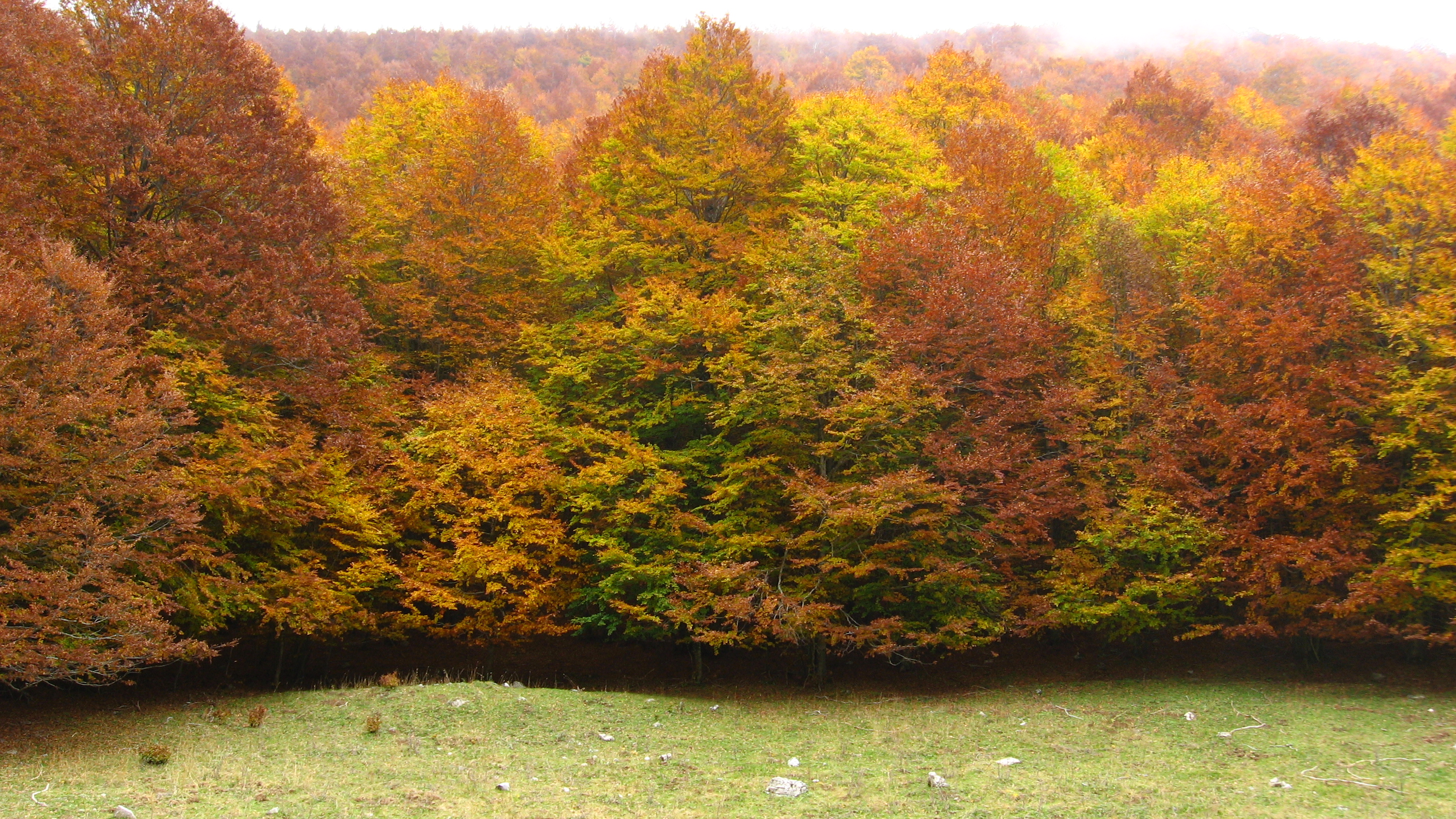
The forests of Calabria — the mountainous toe of the Italian peninsula — include some of the most ecologically intact montane woodlands remaining in the Mediterranean region. On the Sila plateau and the Aspromonte, and across the Pollino massif shared with Basilicata, silver fir (Abies alba) and European beech (Fagus sylvatica) form closed-canopy forests above roughly 900 m that have experienced relatively low levels of management intervention since the mid-twentieth century.
Walking routes through these forests, whether formal trails in the national parks or older mule tracks, do not merely pass through the ecosystem — they alter it. The ecology of the trail margin is measurably different from the closed canopy interior within as little as three to five metres of the path edge, and these differences have predictable consequences for which plant species are present, in what density, and at what time of year.
The Trail as an Ecological Edge
An unpaved trail through a dense beech forest functions as a linear gap in the canopy. Where the trail is narrow (under two metres) and the surrounding trees are tall, the gap effect is limited — light penetration increases mainly at solar noon in summer and has little impact on moisture. But on trails wider than three metres, or where regular foot traffic has compacted and eroded soil, the ecological signature of the edge extends well into the adjacent vegetation.
The key variables are:
- Light: Even a narrow trail admits lateral light in the early morning and late afternoon that the closed canopy blocks completely. For ferns, which evolved under diffuse shade, the direct sunlight reaching fronds at the trail margin during midsummer can cause bleaching and frond tip burn in sensitive species like Athyrium filix-femina.
- Soil moisture: Compacted trail surfaces shed water rather than absorbing it. In dry summers on the Pollino, the zone within 50 cm of the trail edge can be measurably drier than the forest interior — a gradient documented in soil moisture studies conducted in the Parco Nazionale del Pollino research programme.
- Wind: Trails aligned with the prevailing wind direction (typically north–south on the Calabrian Apennines, following the topography) create channelled airflow that increases evapotranspiration in adjacent vegetation, further reducing moisture availability for shade-dependent ferns.
Plant Communities Along Trail Margins
The ecological effect of the trail edge produces a characteristic zonation in ground-level vegetation. Moving from the open trail surface inward:
Zone 1: Trail surface and immediate margin (0–30 cm)
Vascular plants are largely absent from compacted trail surfaces. Where surface disturbance is lower — for example on clay-rich soils in the Sila where trail tread remains soft — Plantago major and Poa annua establish in the wheel ruts of the access tracks used by park management vehicles. These are ruderal species with no ecological significance to the fern community.
Zone 2: Transition zone (30 cm – 2 m)
The transition zone shows the most complex vegetation structure. Dryopteris filix-mas, the most light-tolerant of the woodland ferns present in Calabrian forests, frequently colonises this zone, often growing as isolated specimens with fronds tilted toward the trail opening. Rubus species — blackberry and dewberry — are common competitors in this zone, taking advantage of the elevated light levels to form dense stands that can suppress fern recruitment over several seasons.

Zone 3: Canopy interior (> 2 m from trail edge)
The closed canopy interior supports the full shade-dependent flora of the Calabrian beech and fir forests. At elevations between 1100 and 1500 m on the Pollino, this community typically includes Dryopteris filix-mas (less abundant than at the margin), Phyllitis scolopendrium (hart's tongue fern) in rocky sections with calcareous outcrops, Polystichum aculeatum on steeper slopes, and Oxalis acetosella as the dominant herbaceous groundcover in the deepest shade under closed-canopy beech.
Seasonal Variation Along Trail Corridors
The ecological effect of the trail is not constant through the year. In winter, when the beech has shed its leaves and the canopy is bare, the distinction between trail and forest interior largely disappears in terms of light — both receive full winter sun. The fern populations in the closed interior are already at their minimum metabolic activity, while the trail-edge populations may actually benefit from higher winter temperatures due to reduced cold-air pooling.
Spring is the critical period. As temperatures rise in March and April, fern croziers begin to emerge. At the trail margin, the combination of slightly warmer, better-lit conditions means that male fern populations there may begin crozier development up to two weeks ahead of interior populations at the same altitude. This early-season advantage can translate into larger, more vigorous fronds — but at a cost during drought summers, when the drier trail-edge soil causes earlier senescence.
By mid-June, when the beech canopy is fully closed, the difference between interior and margin becomes most pronounced. The interior maintains its stable, humid, dim microclimate while the trail edge experiences the peak of its ecological stress — higher light, lower moisture, and the additional disturbance of walking traffic flattening emerging fronds.
The Pollino Forests in Context
The Parco Nazionale del Pollino, established in 1993, encompasses roughly 192,000 hectares straddling Calabria and Basilicata. Its forests include some of the last significant populations of the Bosnian pine (Pinus leucodermis / Pinus heldreichii) in Italy — a species confined to rocky ridges above 1600 m that has no direct relationship to the fern understorey but whose presence signals the exceptional ecological integrity of the surrounding forest matrix.
For fern ecology, the Pollino forests are significant because large sections remain unfragmented by roads, creating interior forest conditions — in terms of moisture stability, predator-prey dynamics, and mycorrhizal network continuity — that are unusual in a Mediterranean context. Research published through the GBIF network indicates that Dryopteris filix-mas populations in the Pollino interior show higher frond density per plant compared to equivalent-elevation populations in more fragmented forests further north, a difference attributed partly to stable soil moisture and partly to reduced competition from light-adapted species that colonise only disturbed sites.
Implications for Trail Management
The ecological differences between trail margin and forest interior have straightforward implications for the management of walking routes through sensitive forest areas. Widening trails — even incrementally through lateral foot traffic on soft ground — increases the ecological edge zone and reduces the effective area of closed-canopy interior. Seasonal trail closures in spring, already practised in some protected areas to reduce compaction during the wet period when soils are most vulnerable, also protect the critical crozier emergence window when fern populations are most susceptible to physical damage.
These considerations are taken into account in the management plans of the Parco Nazionale della Sila and the Parco Nazionale dell'Aspromonte, where designated walking routes follow ridge lines or established forestry tracks that minimise new linear disturbance through primary forest stands.
Last updated: 3 May 2026