
Northern Italy's deciduous forests span an unusually wide elevational and climatic range — from the humid lowland boschi of the Po Plain margins at 50 m above sea level to the subalpine beech limit at roughly 1600 m in the Prealps. Within this band, the pteridophyte flora is both diverse and ecologically stratified: different fern species occupy distinct niches defined by canopy composition, soil pH, water availability, and the angle of winter sunlight reaching the forest floor.
The following account covers the most consistently documented species in this region, drawing on herbarium records held at the BGCI partner institutions in Padova and Milan, and occurrence data from GBIF filtered to the Veneto, Trentino-Alto Adige, Lombardy, Piedmont, and Liguria regions.
Dryopteris filix-mas — Male Fern
The male fern is arguably the most widespread pteridophyte in northern Italy's deciduous woodlands. It tolerates a wider range of soil conditions than most co-occurring species, appearing on calcareous substrates under hornbeam (Carpinus betulus) in the lowland fringe, neutral loams beneath oak-dominated mixed forest at mid-elevation, and mildly acidic soils under beech in the Prealps.

Mature plants form compact crowns of 60–120 cm fronds, with the characteristic semi-evergreen habit persisting through mild winters. In the Euganean Hills and on the glacial moraines south of Lake Garda, Dryopteris filix-mas occurs as scattered individuals within hornbeam stands where spring groundwater remains within 40 cm of the surface for at least four months of the year.
Substrate and Associates
Frequent associates in the lowland hornbeam belt include Arum italicum, Geranium robertianum, and Carex pendula along stream margins. At higher elevations, under beech, the male fern grows alongside Oxalis acetosella, Galium odoratum, and Mercurialis perennis — a community indicative of deep, moist, humus-rich soils with moderate nitrogen availability.
Athyrium filix-femina — Lady Fern
Where the male fern is the generalist, the lady fern is the specialist of persistently moist, partially disturbed sites. It reaches its highest density along the margins of forest streams and on north-facing banks where soil moisture does not fall below field capacity even in August. In the Asiago plateau and the Trentino valleys, Athyrium filix-femina forms continuous stands several metres across in stream corridors where canopy cover overhead ranges between 60–80%.
The species is notably sensitive to drought. In years when summer precipitation in the eastern Prealps falls below the 30-year average, frond senescence in lady fern populations begins four to six weeks earlier than in male fern stands at the same elevation. This differential response to water stress is one of the clearest field indicators that separates the two species in the absence of reproductive material.
Polystichum setiferum — Soft Shield Fern
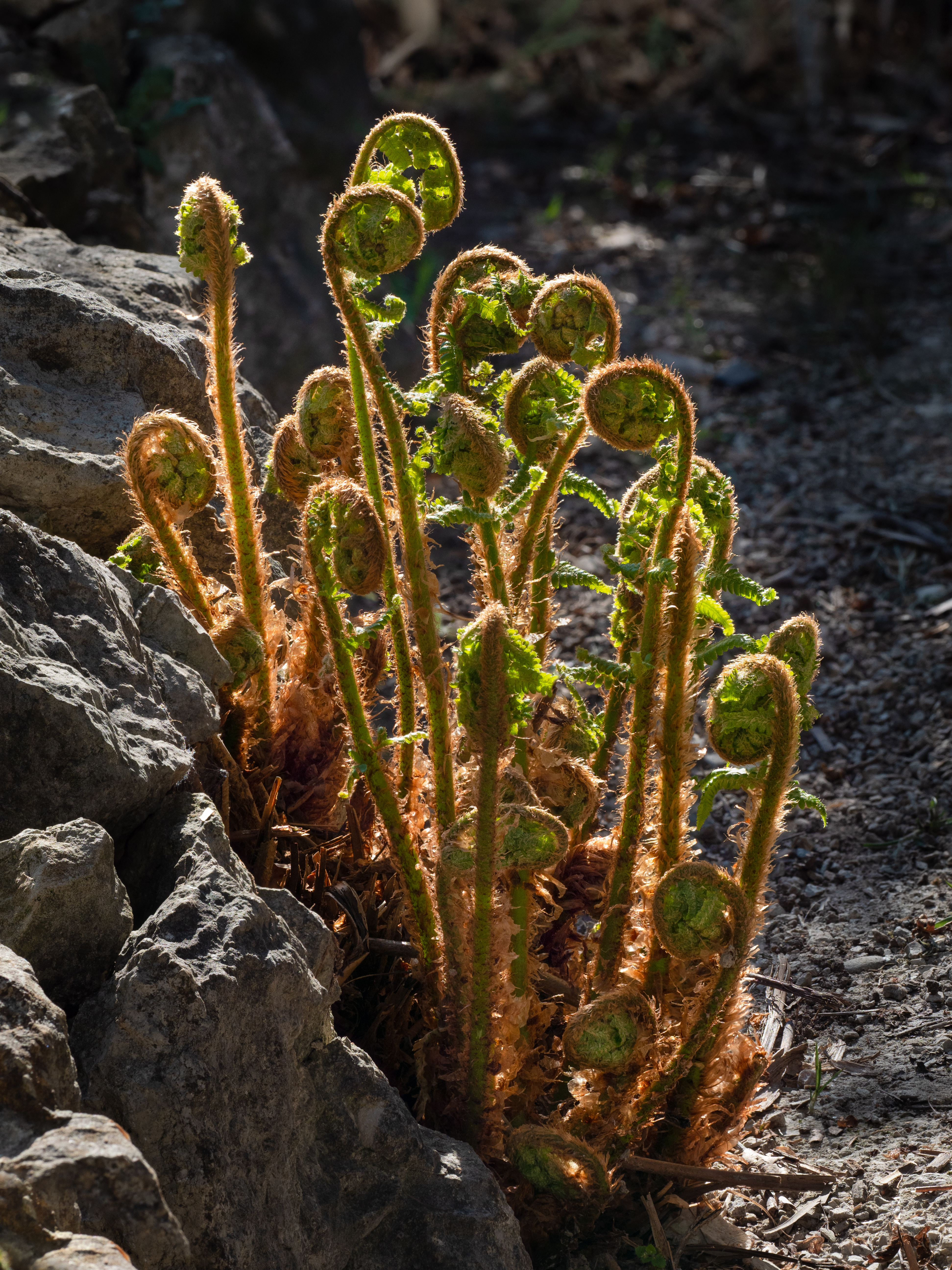
The soft shield fern has a markedly southern distribution within the northern Italian fern flora. In Liguria, it is a characteristic component of the laurel-leaved understorey in mixed evergreen woodland on the coast-facing slopes of the Ligurian Apennines, where winters are mild enough for the fronds to remain green year-round. Moving north into Lombardy and Piedmont, populations become more restricted to sheltered ravines and the warmest aspects of valley sides.
Unlike Dryopteris filix-mas, Polystichum setiferum rarely colonises disturbed ground or secondary woodland. It is most reliably found in old-growth or late-successional stands where soil disturbance has been minimal for several decades — making it a useful indicator species in habitat surveys aimed at identifying ecologically significant woodlands.
Asplenium scolopendrium — Hart's Tongue Fern

The undivided, strap-shaped fronds of the hart's tongue fern make it one of the most immediately recognisable pteridophytes in Italian woodlands. It is strongly calcicole, reaching its maximum density in northern Italy on the Lessini plateau and the Colli Berici, where limestone outcrops within beech and mixed deciduous forest provide the calcareous, well-drained but moisture-retentive conditions it requires.
On the Lessini plateau, hart's tongue frequently grows alongside Phyllitis scolopendrium var. scolopendrium (the same species), Ceterach officinarum on exposed rock faces, and Polypodium vulgare in crevices. The combination of limestone substrate and north-facing exposure creates a local microclimate cooler and more humid than the regional average — a condition replicated, with minor variation, throughout the calcareous Prealps from Bergamo eastwards to Gorizia.
Blechnum spicant — Hard Fern
Hard fern is the most decidedly calcifuge species in this group, confined to acidic soils on siliceous geology. In northern Italy, this restricts it largely to the crystalline massifs of the Lepontine and Carnic Alps, where igneous and metamorphic substrates produce soils with pH values typically below 5.5. It is absent from the calcareous Dolomites and the limestone Prealps except in isolated pockets where podsolisation under long-established spruce or pine has locally acidified the upper soil horizons.
The species is architecturally distinct, producing two types of frond: sterile, spreading fronds that remain close to the ground, and erect fertile fronds with much narrower pinnae bearing continuous sori. This dimorphism is most pronounced in plants growing at the upper range of the species in the Val Malenco and Valchiavenna, where shorter growing seasons concentrate all reproduction into a brief midsummer window.
Seasonal Patterns Across Species
One consistent pattern across the northern Italian fern flora is the sequence of frond emergence in spring, which follows a predictable order linked to temperature sensitivity. Dryopteris filix-mas is typically the first to produce new croziers, beginning in late March in valley-bottom populations. Athyrium filix-femina follows in April, Polystichum setiferum in April–May (later at higher elevations), and Blechnum spicant last — often not completing frond extension until mid-May in the subalpine belt.
This staggered emergence has been noted in long-term monitoring plots in the Trentino forests (data archived with the GBIF network) and corresponds with the sequence in which canopy leaves open above them — with the male and lady fern exploiting the brief early-spring light window before the beech canopy closes in late May.
Last updated: 3 May 2026