
Among all the physical variables that determine which plants grow on an Italian forest floor — soil chemistry, moisture, frost frequency, browsing pressure — canopy density is the one that operates most continuously and at the finest spatial resolution. A change in canopy closure of ten percentage points, equivalent to the loss or gain of a few mature trees per hectare, can shift the ground flora from a diverse fern-and-herb community to a near-monoculture of shade-tolerant grass or bare mineral soil within a few growing seasons.
This sensitivity makes canopy density both a key driver of understory composition and a useful metric for predicting how forest management decisions — selective felling, storm damage, gap creation — will ripple through the ground flora over time.
Measuring Canopy Density and Its Effect on Light
Canopy density is most commonly expressed as canopy closure (the proportion of sky obscured by vegetation when viewed from below) or leaf area index (LAI, a measure of total leaf surface area per unit of ground area). In Italian forest ecology research, hemispherical photography — fish-eye lens photographs taken pointing vertically upward — is the standard field method, producing estimates of both canopy closure and the proportion of photosynthetically active radiation (PAR) reaching the forest floor.
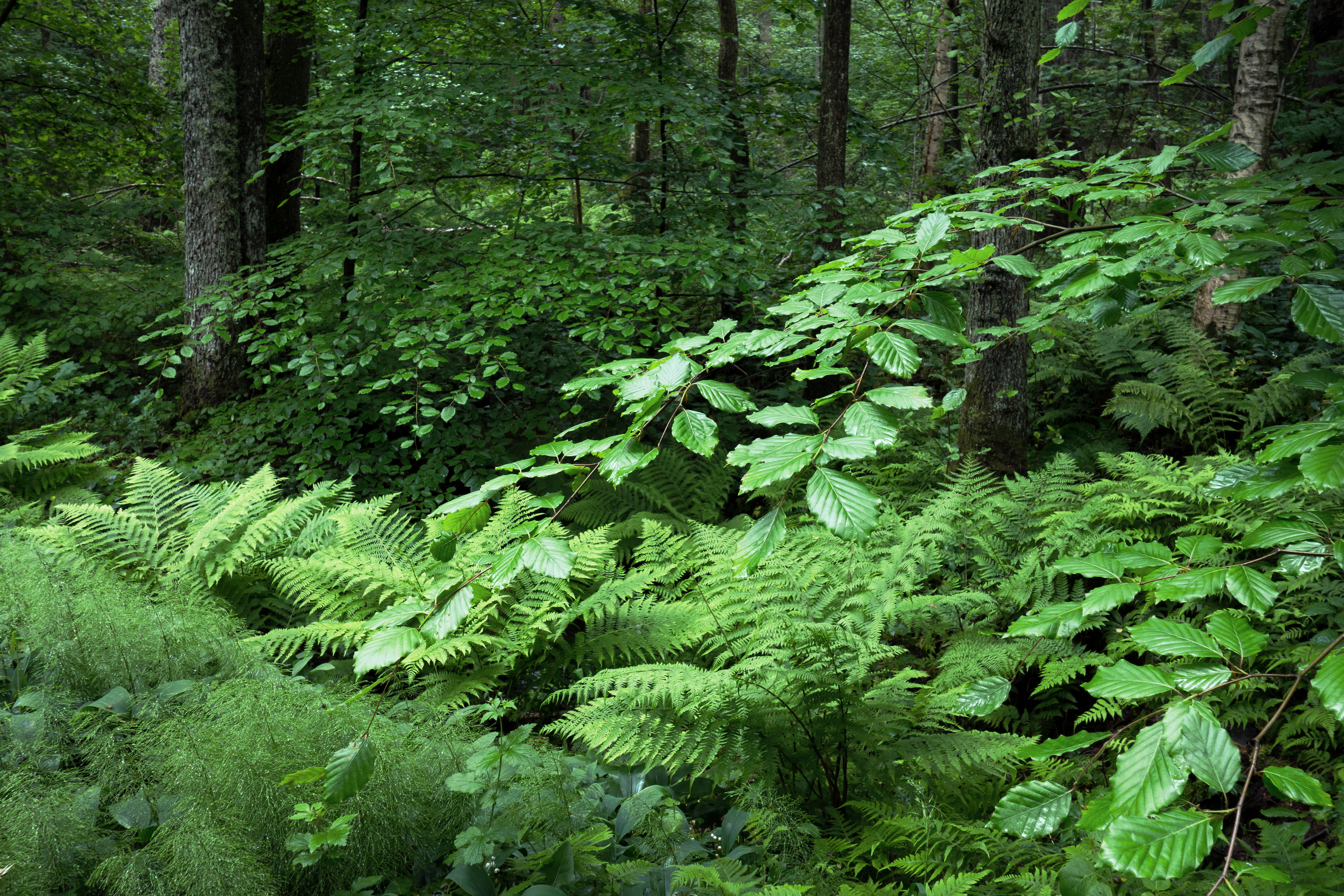
In closed-canopy beech forest in the northern Apennines, PAR at ground level typically falls to 2–5% of above-canopy values in midsummer. For reference, most agricultural crops require 30–60% of full sunlight for productive growth; shade-adapted ferns like Athyrium filix-femina can sustain positive carbon balance at PAR levels as low as 1% of full sunlight, though growth rate and reproductive output are substantially reduced below 3%.
The Spring Light Pulse
Deciduous forests have a property that evergreen forests lack: a brief seasonal window — typically mid-March to late May in northern Italy — during which the canopy is bare or only partially leafed and light penetration to the forest floor can be ten to twenty times higher than in midsummer. This spring light pulse is ecologically fundamental to many ground-layer species, including the majority of woodland ferns.
Dryopteris filix-mas and Athyrium filix-femina both initiate frond growth during this window, timing crozier emergence to coincide with the period of maximum available light before the canopy closes. The photosynthesis accumulated during the spring pulse — lasting perhaps eight to ten weeks — funds a substantial fraction of the plant's annual carbon budget.
The duration and intensity of the spring pulse depend directly on the tree species composition of the canopy. Beech (Fagus sylvatica) leafs out later than oak (Quercus robur, Q. petraea) and much later than hornbeam (Carpinus betulus), meaning that beech-dominated stands offer a significantly longer and brighter spring window than equivalent oak or hornbeam forests at the same elevation. This is one reason why fern diversity tends to be higher in beech-dominated than in oak-dominated forests in Italian phytosociological surveys, even when other site factors (soil, moisture) are similar.
Canopy Closure Thresholds and Species Composition
Field data from monitoring plots in the northern Apennines (Emilia-Romagna and Tuscany regional forest data, accessible via GBIF) suggest three broadly distinguishable canopy closure regimes with different understory communities:
High closure (canopy > 80%)
At very high closure, ground flora diversity is typically low. The dominant strategy is extreme shade tolerance rather than diversity. In Italian beech forests above 80% closure, the characteristic ground layer consists of Oxalis acetosella, scattered Galium odoratum, and sparse fern cover, mostly Dryopteris filix-mas in isolated clumps. Bare humus with a thin layer of undecomposed beech litter covers 40–60% of the ground area. Bryophytes are often more prominent than vascular plants.
Moderate closure (50–80%)
Moderate closure represents the conditions under which fern diversity peaks in Italian forests. The spring light pulse is still substantial, summer shade is adequate for shade-adapted species, and soil moisture remains relatively high due to reduced evapotranspiration from the tree canopy. Typical communities in this range include multi-species fern assemblages (Dryopteris filix-mas, Athyrium filix-femina, and Polystichum setiferum occurring together), along with Sanicula europaea, Lamium galeobdolon, and Mercurialis perennis in the herb layer.

Low closure (< 50%)
Below 50% canopy closure, competitive conditions at ground level shift significantly. Bramble (Rubus fruticosus agg.) and bracken (Pteridium aquilinum) — both highly light-tolerant — begin to dominate over shade-dependent species. Bracken in particular is highly competitive under low canopy: its extensive rhizome network allows rapid lateral spread, and its fronds reach heights that shade out Dryopteris, Athyrium, and Polystichum species. In areas of Italy where forest has been thinned heavily or where storm damage has created large canopy gaps, bracken can form near-monocultures from which recovery of a diverse fern community may take fifteen to twenty years after canopy re-closure.
The Role of Canopy Composition
Beyond closure percentage, the specific tree species forming the canopy influences ground flora in several additional ways:
- Litter chemistry: Beech litter decomposes slowly and acidifies the upper soil horizon over time; oak litter decomposes faster and maintains higher soil pH. The long-term effect of beech dominance is gradual acidification that may eventually exclude calcicole ferns like Asplenium scolopendrium from otherwise suitable sites.
- Root competition: Shallow-rooted trees (including many of the Populus species that characterise lowland riparian forests) compete intensively with ground-layer vegetation for soil moisture in dry summers. The distribution of Athyrium filix-femina in the riparian forests of the Po tributaries is partly shaped by this root competition.
- Canopy texture: A monospecific beech canopy produces a more uniform light environment at ground level than a mixed oak-hornbeam-chestnut canopy of the same closure percentage. Mixed canopies create more spatial variation in ground-level light, supporting higher spatial heterogeneity in the ground flora — more species, but at lower individual density per species.
Climate Change and Canopy Dynamics
Changing precipitation patterns in Italy — with projections indicating drier summers particularly in the south and centre, and altered spring temperature sequences affecting budburst timing — are expected to modify both canopy closure dynamics and the composition of the tree layer itself over the next several decades. Earlier budburst in beech, linked to warmer spring temperatures, would shorten the spring light pulse available to ground-layer ferns, potentially reducing the competitive advantage of shade-adapted species relative to more opportunistic light-tolerant herbs.
Long-term monitoring data from the Italian national forest inventory and from university research plots in Toscana and Umbria will be essential for tracking whether changes in fern community composition over time can be attributed to this mechanism rather than to changes in management or deer browsing pressure — two confounding factors that are also changing simultaneously in many Italian forest landscapes.
Last updated: 3 May 2026